Thursday, 12 September 2013

PERSONALITY 1.7

PERSONALITY 1.7
[Self Awareness Through JOHARI WINDOW]


1. It is named after the first names of inventors and American Psychologists, JOSEPH LUFT & HARRY INGHAM. 
2. This model shows, what one is conscious of in one’s social exchange and what one is not.    
3. A four paned “window” divides personal awareness into four different types, represented by four quadrants: I. Open Self II. Hidden Self III. Blind Self IV. Unknown Self. 
4. These quadrants represent total person. 
5. Johari Window is a simple and useful tool for improving Self Awareness, Mutual Understanding and Group Relationship.
6. When Blind Quadrant is revealed to the sender by receiver, the feedback is taken positively and personality is corrected immediately. Thus Personality is improved. 
7. It is one of the most useful models describing the process of Human Interaction. 
(to be contunied...)

Tuesday, 10 September 2013

PERSONALITY 1.6

PERSONALITY 1.6
[ANALYSIS of TRANSACTIONS]
COMPLIMENTARY TRANSACTION
  • It takes place when one person’s ego state is as expected by another person’s ego state. 
  • Here, the lines of social transactions are parallel. 
  • There are less chances of conflict. 
  • Both the persons are satisfied and communication is complete.
Complimentary Transactions are,
Adult – Adult Transaction
Adult – Parent Transaction
Parent – Parent Transaction*
Child – Child Transaction*
Adult – Child Transaction
Parent – Child Transaction
Child – Parent Transaction
Child – Adult Transaction
Parent – Adult Transaction

*depends on the level of understanding and cooperation.


Crossed/ Non Complementary Transaction
  • It may occur when stimulus – response lines are not parallel but crossing to each other. 
  • One starts with one ego state expecting particular ego state from another person but another person responds at unexpected ego state. 
  • Expected ego state not received resulting interpersonal conflict. This may hurt feelings and cause frustration on the part of both of the parties.

(to be continued...) 

PERSONALITY 1.5

 PERSONALITY 1.5
[TA & EGO STATES]
Transactional Analysis, commonly known as TA is an integrative approach to the theory of psychology and psychotherapy. It was developed by Canadian-born US psychiatrist Eric Berne during the late 1950s. Berne presented his theories in two popular books on transactional analysis: Games People Play (1964) and What Do You Say After You Say Hello? (1975). Berne observed that there are several different people inside  every person. TA is a technique of analysing and understanding interpersonal behaviour. TA is a improved study of social transaction when two persons encounter and interact with each other.
TA is an effective technique due to,
  • Effective Communication Without Any Understanding
  • Overcoming Conflicts
  • Good Interpersonal Relationship
note: 
  1. One’s interaction with other, is called the Transaction Stimulus.
  2. The reaction from the other person is called the Transaction Response.
  3. The person sending stimulus is called Agent.
  4. The person who responds is called Respondent.
  5. And this relation is called Dyadic Relation (relation of two).

 EGO STATES
  • While interacting with others, we adopt particular behaviour patterns i.e. particular ego state. It’s a person’s way of thinking, feeling and behaving.
  • The three ego states are: Parent, Adult and Child.
  • It has no relation with our chronological age, It’s related with our particular behaviour.
  • Ego states are present in every person.
  • We move from one ego state to another as per requirement.
  • It’s a dominating state at that particular time.
note: Parent, Adult and Child, - These three personality instances have parallels to the superego, ego, and id of Freudian thought, and are given the added names Exteropsyche (Parent), Neopsyche (Adult), and Archaeopsyche (Child). 

PARENT: At this ego state we feel, think and behave like parent figure. It represents that part of personality which is authoritative, advising, protecting, nurturing,  righteous and critical. 

ADULT: At this ego state we feel, think and behave like adults in mature way. Processing well, reasoning, logical thinking and dealing fairly and neatly is of the Adult. At this state, we control emotions and believe in fairness. It forms through experience, knowledge and training. 

CHILD: At this ego state we feel think and behave like a child. It represents the childlike, innocent, emotional, sometimes immature, illogical or impulsive part of our personality. In Transactional Analysis (TA) the Child is also seen as the source of creativity and imagination.


(to be continued...)

Wednesday, 4 September 2013

PERSONALITY 1.4

PERSONALITY 1.4
[Theories of Personality]
IV. BIG 5:
In 1990, ‘BIG 5’ model was published. The Big five factors are Openness, Conscientiousness, Extraversion, Agreeableness, and Neuroticism (OCEAN, or CANOE if rearranged). Each of these 5 personality traits describes, relative to other people, the frequency or intensity of a person’s feelings, thoughts, or behaviors. Everyone possesses all 5 of these traits to a greater or lesser degree. The big five traits are also referred to as the "Five Factor Model" or FFM. 

1. Openness to Experience 
  • “I have a rich vocabulary.” 
  • “I have a vivid imagination.” 
  • “I have excellent ideas.” 
  • “I spend time reflecting on things.” 
  • “I use difficult words.” 
  • “I am not interested in abstractions.” (reversed
  • “I do not have a good imagination.” (reversed
  • “I have difficulty understanding abstract ideas.” (reversed)
 2. Conscientiousness
  • “I am always prepared.” 
  • “I am exacting in my work.” 
  • “I follow a schedule.” 
  • “I get chores done right away.” 
  • “I like order.” 
  • “I pay attention to details.” 
  • “I leave my belongings around.” (reversed
  • “I make a mess of things.” (reversed
  • “I often forget to put things back in their proper place.” (reversed
  • “I shirk my duties.” (reversed)
3. Extroversion
  • “I am the life of the party.” 
  • “I don't mind being the center of attention.” 
  • “I feel comfortable around people.” 
  • “I start conversations.” 
  • “I talk to a lot of different people at parties.” 
  • “I am quiet around strangers.” (reversed
  • "I don't like to draw attention to myself.” (reversed
  • “I don't talk a lot.” (reversed“I have little to say.” (reversed
4. Agreeableness
  • “I am interested in people.” 
  • “I feel others’ emotions.” 
  • “I have a soft heart.” 
  • “I make people feel at ease.” 
  • “I sympathize with others’ feelings.” 
  • “I take time out for others.” 
  • “I am not interested in other people’s problems.” (reversed
  • “I am not really interested in others.” (reversed
  • “I feel little concern for others.” (reversed
  • “I insult people.” (reversed
  • “I like being isolated.” (reversed
5. Neuroticism

  • “I am easily disturbed.” 
  • “I change my mood a lot.” 
  • “I get irritated easily.” 
  • “I get stressed out easily.” 
  • “I get upset easily.” 
  • “I have frequent mood swings.” 
  • “I often feel blue.” 
  • “I worry about things.” 
  • “I am relaxed most of the time.” (reversed
  • “I seldom feel blue.” (reversed

note: know your Personality on the basis of BIG 5. Let's See How?!!

V. SELF THEORY:
Self Theory is also termed as 'Organismic Theory' or 'Field Theory'. The most important contribution in Self Theory comes from Carl Rogers. There are four factors of self concept,

A. Real Self: The real self is what one really is. The first three aspects of self concept are the functions of individual perception and they may be same as real self or different from it.  

B. Looking Glass Self: The looking glass self is the perception of a person about how others are perceiving his qualities and characteristics. This is a perception of others' perception.  

C. Self Image: By nature, every person has certain beliefs about what or who he/ she is. Self image is the way one sees oneself. Individuals on the basis of these beliefs form self image or identity.

D. Ideal Self: The ideal self refers to what one would like to do, what one would like to be. While self image indicates reality of a person, ideal self implies ideality of a person. It also motivates an individual in a certain way.

note: A person perceives a situation depending upon his self concept which has direct influence on his behaviour. Self concept theory plays a very important role in analyzing organisational behaviuor (OB).


(to be continued...)

Tuesday, 3 September 2013

PERSONALITY 1.3

PERSONALITY 1.3
[THEORIES OF PERSONALITY]
I. Introvert - Extrovert Theory
II. Type 'A' - Type 'B' Theory

Type A: They are hard working, impatient, aggressive, competitive  high achievement oriented, productive and workaholic.

note: The following are the characteristics of the type A personality,
  • Type A’s has got a severe sense of time urgency. 
  • They are always running and can hardly relax. If they sat without doing something useful they may end up feeling guilty.
  • Type A’s are over achievers, they usually get themselves involved in many different unrelated activities and perform well in them all.
  • Type A's biggest problem is stress, they are usually overwhelmed by the amount of tasks they have to do. These tasks are usually a huge list that they planned for themselves.
  • Type A is usually competitive and has a high challenging spirit.
  • They find it difficult to stop, even when they have achieved goals.
  • They feel the pressure of time, constantly working flat out.
  • They are almost over achievers. They hate failure and will work hard to avoid it.
  • They are generally pretty fit and often well-educated (a result of their anxiety).

Type B: They are easy going, social, not time bound, better with work involving judgement.

note: The following are the characteristics of the type A personality,
  • Type B personality is almost the opposite of Type A.
  • This type of person is relaxed by nature and has no sense of time urgency.
  • Type Bs have got no problems relaxing or sitting without doing anything.
  • Type Bs may delay the work they have to the last moment and they usually don't get stressed that easily.
  • Type B could be an achiever too as his lack of sense of time urgency helps him much in not feeling stressed while doing his tasks.
  • The Type B personality generally lives at a lower stress level.
  • They work steadily, enjoying achievements but not becoming stressed when they are not achieved.
  • When faced with competition, they do not mind losing and either enjoy the game.
  • They may be creative and enjoy exploring ideas and concepts.
  • They are often reflective, thinking about the outer and inner worlds.
III. Id, Ego and Superego Theory

This Theory is composed of three elements: Id, Ego and Super Ego all developing at different stages in our lives. These are systems, not parts of the brain, or in any way physical. 

The id (or it)

Id is the original and the most basic system of human personality. The id consists of all the inherited (i.e. biological) components of personality. The id is the impulsive (and unconscious) part of our psyche which responds directly and immediately to the instincts. The personality of the newborn child is all id and only later does it develop ego and super-ego. The id demands immediate satisfaction and when this happens we experience pleasure, when it is denied we experience ‘unpleasure’ or pain. The id is not affected by reality, logic or the everyday world. On the contrary, it operates on the pleasure principle which is the idea that every wishful impulse should be satisfied immediately, regardless of the consequences. It demands immediate pleasure at whatever cost. Id is largely childish, irrational, never satisfied, demanding and at times destructive to others.  

The Ego (or I)


As an individual learns to separate the unreality from reality in childhood, the ego develops. The ego is the reality oriented part in thinking, it is largely practical. This is associated with the realities of life. With its logic and intellect, ego of a person keeps the Id in check. The ego develops in order to mediate between the unrealistic id and the external real world. Ideally the ego works by reason whereas the id is chaotic and totally unreasonable. The ego operates according to the reality principle, working our realistic ways of satisfying the id’s demands, often compromising or postponing satisfaction. Like the id, the ego seeks pleasure and avoids pain but unlike the id the ego is concerned with devising a realistic strategy to obtain pleasure.  Freud made the analogy of the id being the horse while the ego is the rider. Often the ego is weak relative to the head-strong id and the best the ego can do is stay on, pointing the id in the right direction. 

The Superego (or above I)

The super ego is the higher level force to restrain the Id. It represents noblest thoughts, ideals, feelings. It is also labeled as 'ego-ideal' that tells the individual what is acceptable. The superego incorporates the values and morals of society which are learned from one's parents and others. It also has the function of persuading the ego to turn to moralistic goals rather than simply realistic ones and to strive for perfection. The superego consists of two systems: The conscience and the ideal self. The conscience can punish the ego through causing feelings of guilt.  For example, if the ego gives in to id demands, the superego may make the person feel bad though guilt. The ideal self (or ego-ideal) is an imaginary picture of how you ought to be, and represents career aspirations, how to treat other people, and how to behavior as a member of society. Behavior which falls short of the ideal self may be punished by the superego through guilt. The super-ego can also reward us through the ideal self when we behave ‘properly’ by making us feel proud. 
note: (i) Id requires instant pleasure/ gratification. (ii) Ego wants reality. (iii) Super-ego goes for perfection. 


(to be continued...)

Monday, 2 September 2013

PERSONALITY 1.2

PERSONALITY 1.2
[Concept of PERSONALITY]
"Personality may be defined as the most characteristic integration of an individual’s structures, modes of behaviour, interests, attitudes, capacities, abilities, and aptitudes.”
                                                                               - Author Unknown

                                           
PERSONALITY = PERSONARE (Latin Word)
PERSONARE    = ‘to Speak Through’
PERSONA       = Mask/ Dress Up 'as One Appears to Others'

Meaning of Personality
Personality is the sum total of ways in which an individual reacts to and interacts with others. It’s the combination of behaviors, attitudes, beliefs, and values that are characteristic of an individual.

Personality Patterns:
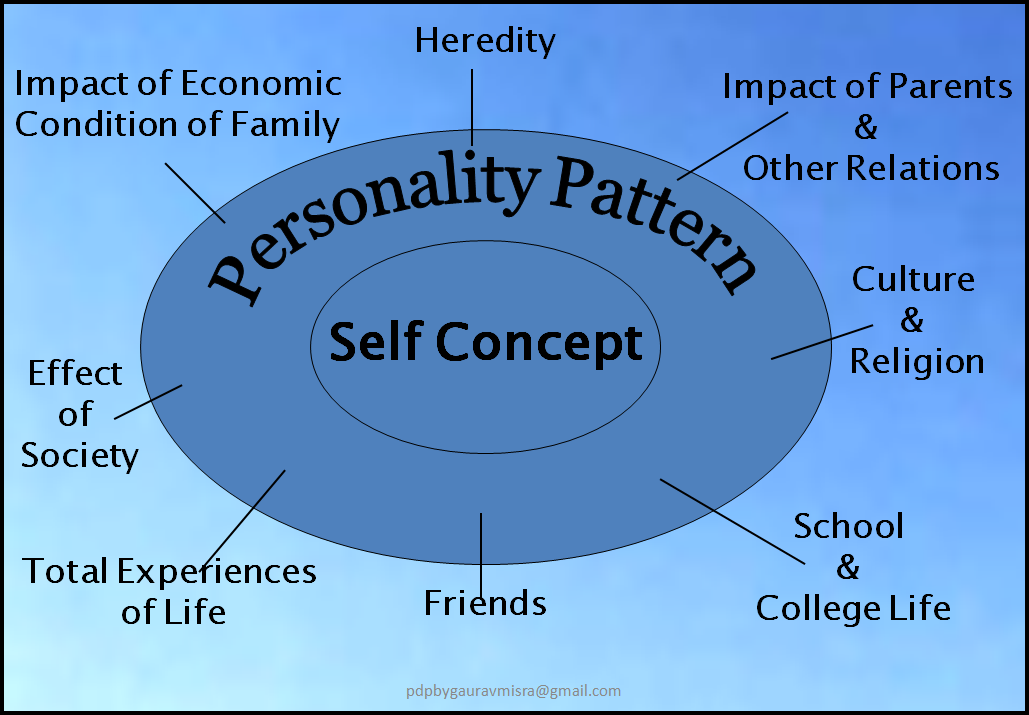
The personality pattern is the design or structure of personality. It involves all that shape up a personality. It comprises of unique characteristics, particular traits, behavior pattern, unique attitude etc. that help in the adjustment with the changing environment.


Major Factors in Determining the Development of Personality Pattern

  1. HEREDITY
  2. SOCIAL & ENVIRONMENTAL FACTORS
1. Heredity
  • Major part of personality influenced
  • Fixed, Cannot be altered
  • Physique, Color of eyes, Features, IQ, Height, Hair color etc.
2. Social & Environmental Factors
  • Family Members, the Way We Are Brought Up, Relations and Experiences with Family Members, Social Pressure Inside the Home.
  • Impact of School, College, Friends, Colleagues at Work, Social Pressure Outside the Home.
SELF CONCEPT:
Major Component of Personality Pattern
a. “What I Am…What I Have Been…What I might Become…”
b. Self Concept is a Very Private Region of Our Life/ Our Inner World.
c. Self Concept is a Very Private Region of Our Life/ Our Inner World.
d. Self Concept is Known with Many Names: Self System/ Attitude Towards Self/Organized Configuration of Perceptions of Self.
e. Self Concept is Something of Which We Are Immediately Aware.
f. Self Concept includes Our Thoughts, Our Feelings, Hopes, Fears, Dreams, Desires.
g. Self Concept influences Our Behaviour, Attitude,  Adjustment to People & to Life Situations.
h. Self Concept is, In Fact, Our SELF ESTEEM. [either + or -] 


Let’s Revise… 


(to be continued...)

Sunday, 1 September 2013

PERSONALITY 1.1

PERSONALITY 1.1
Personality means the characteristics and appearance of a person - his thoughts, feeling, behaviour, communication ability and physical features. A child inherits many personality traits from its parents. The personality of a person takes its basic formation during early childhood. A child's experiences in the family and the society are very crucial. Friends, teachers and the environment of the school have their own positive or negative impact. Parents need to be very careful while rearing a child. To develop positive thinking in the child, they must relate to each other in a positive way. Parents simply can't deny the fact that they have to learn this to teach their children to make them fit for the 21st century.

Previously, it was thought that every person lived his or her whole life according to the personality script written in childhood. To change was almost impossible. But after years of research and practical applications the view has changed. With the help of simple methods anybody can develop a winning personality and change his or her future. A few years ago parents rarely gave any importance to personality development of their children. Emphasis was given only on physical appearance and expertise in work. But now the time has changed. It is an age of competition and economic revolution. To reach the goal of vision 2020, we have to implant the seeds of personality development in our young generation right from their boy/girlhood, which will pay off tremendously in their future life.
With the help of good training a child or an adult can learn communication skills, different subjects, driving or computer operating. Similarly, training in personality development enhances the general as well as unique traits (characteristics which differentiate one from others) of a person. A teacher of personality development helps a person to get positive thought pattern, gain confidence, improve behaviour, learn better communication and develop a healthy physique. Many people still think that personality is related to the physical appearance of a person. If a person is well-built and wearing a good dress it is said that he/she has a good personality. But this is not a rational approach. In case the inner personality of a person is weak he/she will lose impact as soon as he/she speaks or acts. Such a person fails to create a lasting impression on others, and rising in his/her career becomes a very difficult task. Therefore, both the inner and the outer personality of a person should be strengthened.
Now the million-dollar question is how to brush up on your personality so that people say: "Here goes a person with personality!"Try these simple but highly effective tips:
Set an Aim in Life: If you sit in the boat of life without knowing your destination you will become the slave of circumstances and other people. Your progress or development will totally depend on your luck. To change this scenario you need to set an aim for your life. It is true that a person has several aims in life but to decide the chief aim is essential to make good progress. When you have an aim it is like a destination -- you can chart your route, plan your action and formulate strategies to reach there quickly.
Power of Knowledge: Knowledge is power. Nobody is impressed with a person who doesn't even know what is happening in the world. He is considered a fool whom no wise man or woman would like to befriend or follow. Therefore, it is necessary to enrich your general knowledge, and you should be the master of the field in which you are working. To update your general knowledge: a) read newspaper, b) watch informative programmes on TV, c) read good and popular books, d) interact (interrelate, communicate) with intelligent persons.
Look Confident:  A look of confidence on your face impresses everybody. If you walk with a feeling of failure and frustration on your face people will simply avoid you. Even if you are facing difficulties and worries in your life, you must know how to think and look positive. Shake hands with others firmly. While shaking hands or talking make eye contact with others and don't forget to wear a smile!
Speak Well: Most of the successful persons maintain a unique style in speaking. They speak clearly and forcefully. Be careful that you have a good command on the language you speak. Don't make grammatical mistakes else you may become a laughing stock. If necessary take training from a good teacher. Give extra care to your pronunciation. Speaking power is an essential trait of any good personality.
Dress Smart: A smartly dressed person is admired everywhere. By observing successful people in any field, you will come to the conclusion that most of the successful persons in almost every field have a keen taste for good dresses. Good dresses also prove a stimulus for the wearer. He/she feels more confident and relaxed.
A Healthy Body: A body burdened with disease may get pity of others but it is very difficult for that person to maintain an attractive personality. A healthy and smart look is absolutely essential to attract others. And if you work on it you can easily attain it. Take exercise regularly, play games or go for a morning walk -- whatever suits your body and psychology. Eat a balanced diet.
Good Habits: A man is generally a creature of his habits. With bad habits you may become a sheer nuisance for others. Then how will you impress them? Cleanliness, punctuality, completing your work on time, fulfilling your promises, having sincerity and dedication to work, listening to other people with empathy, keeping yourself away from smoking and drinking are the habits which add sparkle and dynamism to your personality. They endear you to people. Last but not the least, you are what you think you are.
…so, Think Big and Live Large!
(to be continued...)